Author Bio
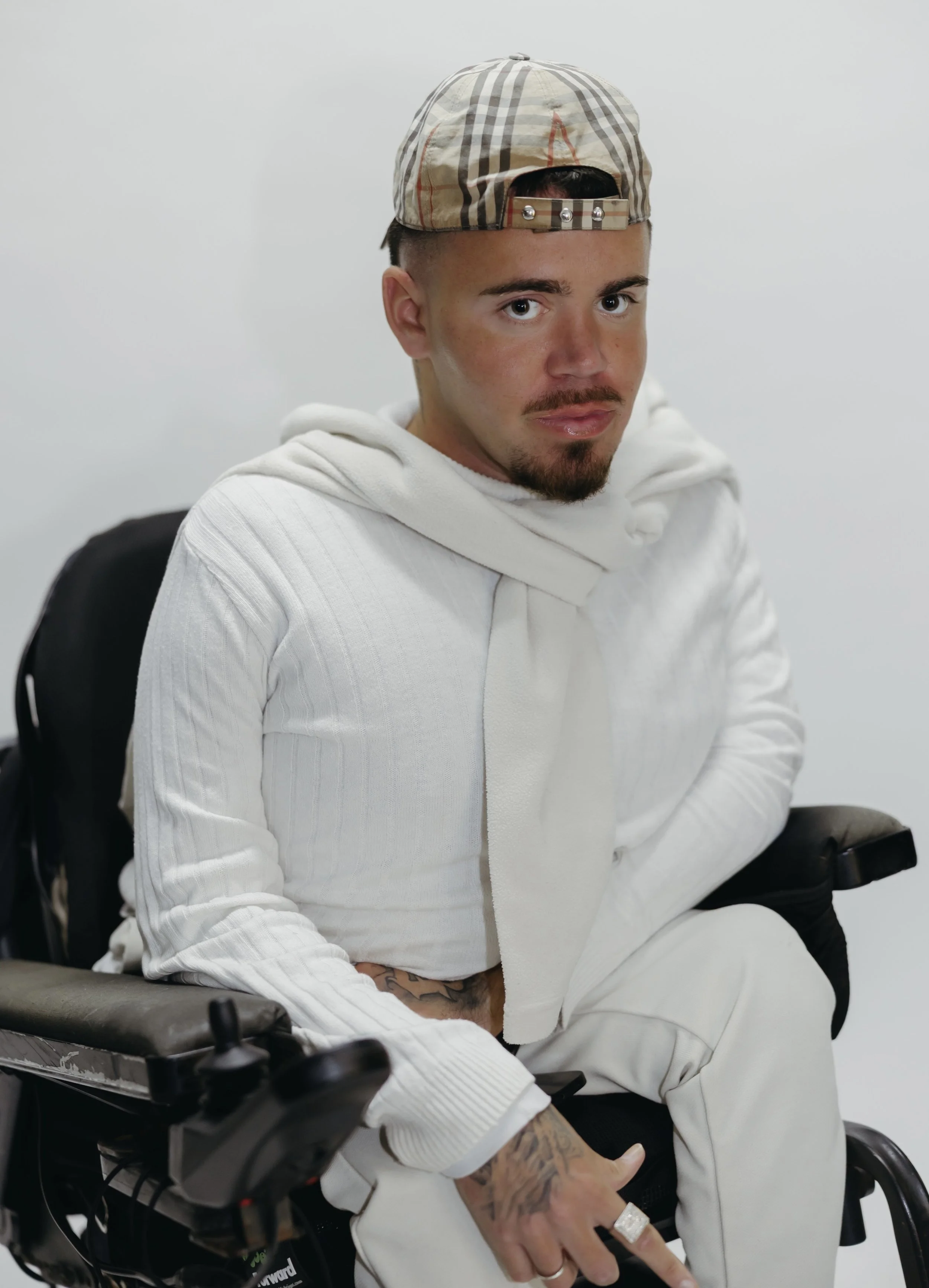
Tom Oliver is a model, actor, Spotify artist, writer, and creative living with limb-girdle muscular dystrophy, a condition that led him to use an electric wheelchair from childhood. After six years working at Volkswagen, Tom transitioned into the creative industry, already landing work with the Australian ATO and featuring in the Black Dog Institute’s One Step Forward campaign and multiple other shoots. Known for his confidence, charisma, and resilience, he has spent his entire life challenging perceptions of disability by living with authenticity, humour, and heart.
Tom’s story, however, didn’t begin in front of a camera.
His life has been shaped by a series of pivotal moments — moments that pushed him, broke him, and ultimately built the person he is today.
When he was 12, Tom’s mum called his Year 6 coordinator worried about how he was coping socially. The teacher replied, “He’s in the cool group… he’s actually the leader of it.” That surprised his mum — but it didn’t surprise Tom. Even as a kid, people naturally gravitated toward him.
At 14, he overheard a phone call that would change everything. Centrelink asked his mum if his condition was terminal. She said yes. Tom already knew deep down, but hearing it out loud was different. He walked outside, looked up at the sky, smiled, and said to himself:
“Let’s ride this life ’til the wheels fall off.”
Fear wasn’t what he felt. It was determination.
By 16, Tom was surrounded by love — friends who adored him, girls who liked him, people who would help him with anything he needed. He told his mum he felt like he owed his life to his friends. She replied, “They help you now, but in ten years, you’ll help them more than ever.”
She was right.
Throughout his early twenties, people constantly came to Tom for advice. He found himself inspiring others simply by being who he was. At his 25th birthday, he shared that same line from his mum, and half the room cried — many of them admitting that whenever they feel overwhelmed, they think of Tom and remind themselves to be grateful.
But Tom’s journey hasn’t been clean or perfect.
In his early twenties, he fell into frequent drug use, which eventually led to a suicide attempt at 23. He overdosed in a hotel, and police tracked his phone just in time. Paramedics told him he was fifteen minutes away from dying. He spent four days on life support in St Vincent’s Hospital.
It wasn’t the only close call.
There were multiple moments — some mental health related, some living recklessly, being put in an ambulance 5 times in 6 months— where he should have died. After the final incident, a doctor knelt beside his wheelchair, eyes watering, and said:
“You don’t have nine lives. You have ten.”
That was the moment Tom chose to get sober.
As he puts it,
“Being at war with your mind is so much worse than being at war with your body.”
Tom also speaks openly about the ways his life has been different from what people assume life in an electric wheelchair must be. He’s had relationships, intimacy, confidence, and experiences that many people using an electric wheelchair often find it harder to have or won’t have. As one of his OTs once said, “It’s sad how many of my clients say, ‘I just want to talk to a girl.’ Tom’s life has never fit the stereotype — and he hopes his story expands the world’s understanding of what disability can look like: full, complex, messy, beautiful, human.
Today, Tom channels his resilience into storytelling — modelling, acting, writing, and sharing the truths most people are too afraid to say out loud. His debut poetry collection, Still Fire, reflects the rawness of his journey: the highs, the chaos, the near-death moments, the healing, and the decision to keep choosing life with gratitude and courage.
Tom’s mission is simple:
to turn his lived experience into something that helps others survive theirs.
Viewer advisory: This video contains graphic images of a health emergency.